 Pin it
 I'll never forget the afternoon I attended a modern art exhibition and found myself captivated by a painting where bold, dense brushstrokes gradually dissolved into delicate wisps of color. That evening, standing in my kitchen with a handful of freshly sliced vegetables, I wondered if I could translate that same sense of motion onto a plate. The Kinetic Motion Blur was born from that moment—a dish that challenged everything I thought I knew about plating, proving that food could be as visually arresting as any canvas.
I served this for the first time at a dinner party where a friend had just gotten back from studying art history in Italy. As she took her first bite, her eyes widened—not just at the visual composition, but at how the honey-lemon dressing brought everything together in a way that felt both unexpected and inevitable. That's when I knew this dish had become something special to me, something that bridged my love of cooking with my appreciation for design and storytelling.
Ingredients
- Golden beet, thinly sliced: The sweetness of golden beets is gentler than red, and they won't bleed color everywhere, which matters when you're creating a precise visual effect. I learned this the hard way after staining half my platter deep purple.
- Red beet, thinly sliced: These add that jewel-tone depth and earthiness that grounds the dish. The color contrast against the golden beets is non-negotiable for the visual impact.
- Watermelon radish, thinly sliced: Here's where the magic happens—those gorgeous pink and white concentric circles feel almost too perfect, like nature was in on the artistic vision.
- Persian cucumber, thinly sliced: Their thinner skin and smaller seeds make them less watery and more elegant than regular cucumbers. This matters when you're layering delicate slices.
- Baby carrots, bias-sliced: The angle cut catches the light differently, and the slight sweetness of baby carrots complements the earthiness of the beets beautifully.
- Creamy goat cheese, room temperature: Cold goat cheese is impossible to dollop; letting it come to room temperature makes it spreadable and allows it to melt slightly into the vegetables. This is essential.
- Toasted hazelnuts, roughly chopped: Toasting them yourself is crucial—it wakes up their flavor completely and adds a textural element that raw nuts simply can't provide.
- Black sesame seeds: They add visual drama and a subtle nuttiness. They also stay exactly where you put them, unlike white sesame seeds which can feel chaotic in a composed dish.
- Microgreens (arugula or radish): These are your freshness anchor. Their peppery bite is what keeps this from feeling like just a pretty salad.
- Fresh dill, fronds only: Use just the delicate fronds, not the stems. The aroma alone prepares your palate for what's coming.
- Extra virgin olive oil: This is tasted, not just used as a cooking medium, so quality genuinely matters here.
- Fresh lemon juice: The acid is what pulls all these disparate flavors together and prevents the dish from tasting one-dimensional.
- Honey: Just a teaspoon, but it rounds out the dressing and plays beautifully with the goat cheese's tanginess.
Tired of Takeout? 🥡
Get 10 meals you can make faster than delivery arrives. Seriously.
One email. No spam. Unsubscribe anytime.
Instructions
- Make your dressing first:
- Whisk together the olive oil, lemon juice, honey, salt, and pepper in a small bowl. Taste it—it should make your mouth water slightly. Set it aside while you work on the plating. This way, the flavors have a moment to marry before they hit the vegetables.
- Create the dense cluster:
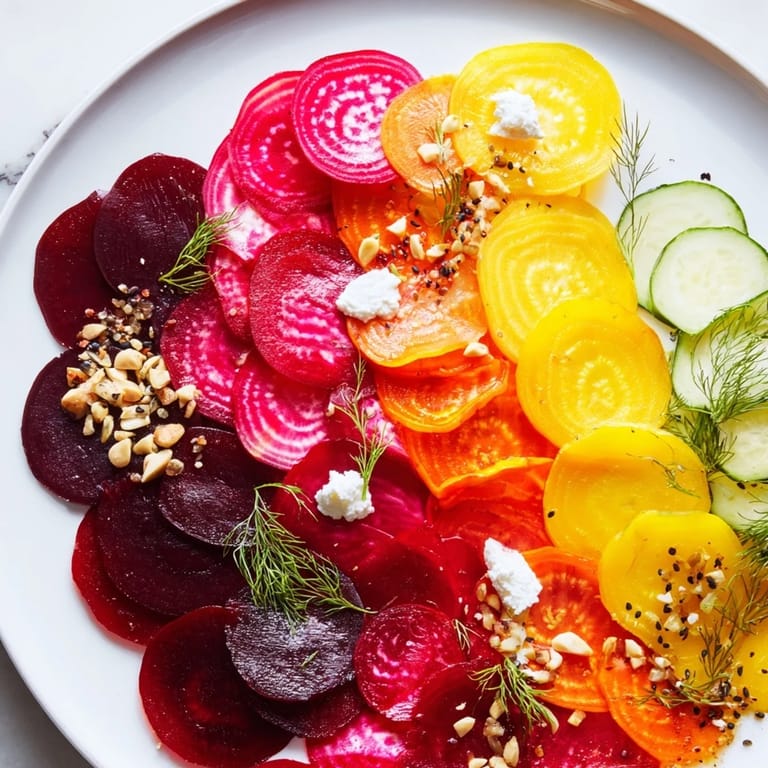
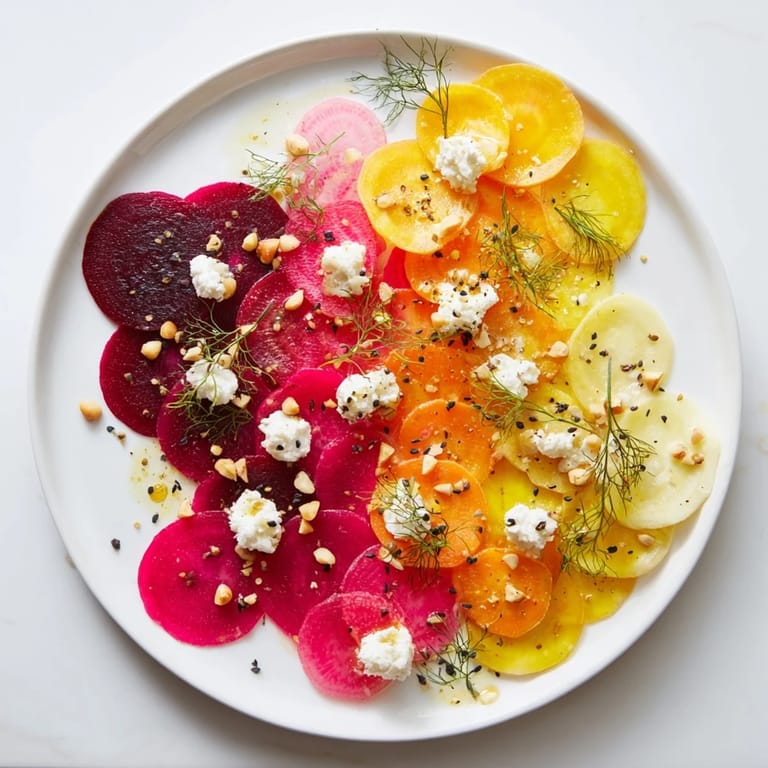
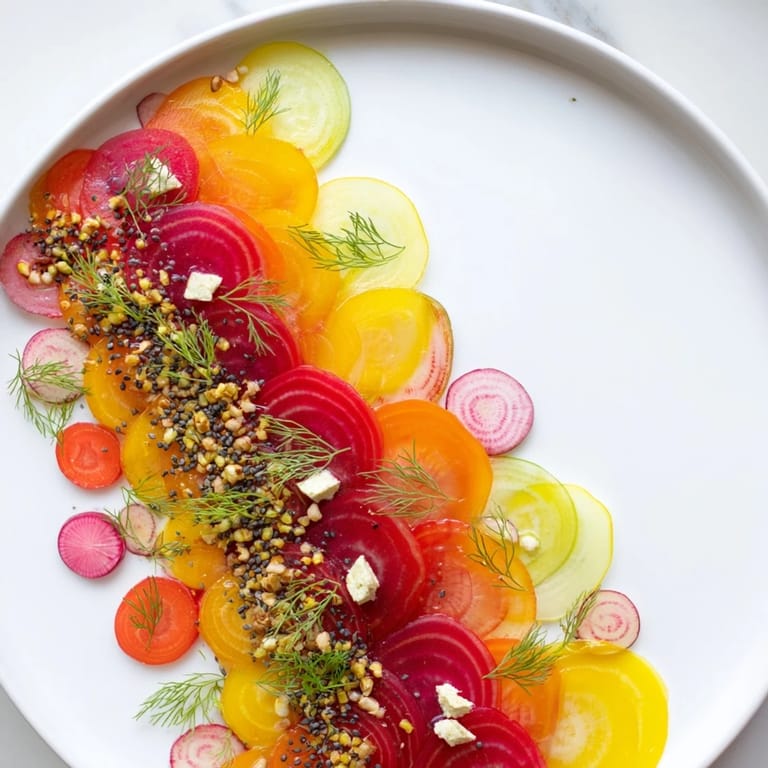
- On your platter or plate, begin overlapping vegetable slices tightly on one side, creating a beautiful, almost layered composition. Think of it as the heart of the motion, where everything is concentrated and vibrant. This is where you'll see the most color variation.
- Execute the fade:
- As you move across the platter toward the opposite edge, begin spacing the slices further apart, creating a sense of the vegetables dispersing outward. It should feel intentional, like the motion is slowing down and dissipating. This gradient is what gives the dish its kinetic feeling.
- Distribute the goat cheese:
- Place small dollops of the creamy goat cheese among the densest vegetable cluster, then gradually reduce them as you move toward the sparse side. The creaminess should anchor the vegetables in the dense area while providing visual contrast.
- Trail the hazelnuts and sesame:
- Sprinkle the toasted hazelnuts and black sesame seeds, again starting heavy on the dense side and fading toward the edge. Run your fingers over the plate lightly to ensure even distribution where needed, but respect the gradient you've created.
- Final scatter with greens:
- Scatter the microgreens and dill fronds last, concentrating them where the vegetables are densest and letting them trail off. The greens should feel almost ethereal on the sparse side, catching the light.
- Dress the plate:
- Drizzle the dressing evenly across, but use a lighter hand on the sparse side to preserve the visual effect. Some of the vegetables will glisten with it, others will remain more matte. Both are intentional.
- Serve immediately:
- The moment you finish plating is the moment to serve. The vegetables maintain their snap, the microgreens stay perky, and the whole composition is at its visual peak.
 Pin it
 There's a moment right before you serve a dish like this when you step back and look at what you've created and feel a tiny thrill—this isn't just dinner, it's an experience. That's what this dish has taught me about cooking: that feeding people isn't just about nutrition or flavor, it's about creating a moment they'll remember. The first time someone said, 'I almost didn't want to eat it,' I knew I'd succeeded.
The Art of Visual Composition in Cooking
Creating a dish that's visually arresting starts with understanding that every element on the plate has a job to do. The bright colors of the vegetables aren't just there to look pretty—they signal freshness and nutritional variety. The way you arrange them can make the difference between a plate that feels carefully composed and one that looks accidental. When you're building the kinetic blur effect, you're not just arranging food; you're telling a visual story about motion and intention. This is where cooking intersects with design, and it's where a meal becomes memorable.
The Power of Texture and Temperature
One of the reasons this dish works so well is that it relies entirely on the contrast between textures. You have the firm snap of raw vegetables, the creamy density of the goat cheese, the crunch of toasted hazelnuts, and the delicate brush of microgreens. Each element should maintain its integrity—the vegetables should be crisp, the cheese should be smooth, the nuts should be toasted until they're aromatic. Everything served at room temperature means no element is fighting against another for thermal dominance. The dressing, slightly cool from the refrigerator, provides a final textural counterpoint. This is the kind of attention to detail that separates a good dish from one people talk about for months.
Variations and Seasonal Thinking
While this recipe is written for spring and early summer vegetables, the beauty of the kinetic motion blur concept is that it translates beautifully across seasons. In autumn, you could use roasted beets, thinly shaved Brussels sprout leaves, and substitute toasted walnuts for hazelnuts. In winter, consider adding thinly shaved celery root, sliced persimmons, and even some thinly sliced roasted beets for warmth. The principle remains the same: create a dense cluster that fades into sparseness, and let the vegetables speak for themselves. For a richer version, you could add thin slices of smoked salmon or trout woven through the dense area, bridging vegetarian and pescatarian preferences. If you're serving vegans, a cultured cashew cheese or almond-based spread mimics the creaminess of goat cheese while maintaining the visual impact.
- Always taste the vegetables raw before building your plate—they should be sweet, fresh, and crisp, never mealy or bitter.
- If you're making this more than 15 minutes before serving, cover the plated vegetables loosely with plastic wrap to prevent them from drying out or oxidizing.
- The dressing can be made up to 2 days ahead, allowing the flavors to develop, but dress the plate only when you're ready to serve.
 Pin it
 Cooking something like this reminds you that hospitality and artistry are never at odds—they're partners in the same dance. Serve this when you want people to feel seen, celebrated, and a little bit delighted by their dinner.
Recipe FAQ
- → How is the kinetic blur effect achieved?
It’s created by arranging vegetable slices densely on one side of the platter and gradually scattering them toward the opposite side, producing a fading motion effect.
- → What type of cheese complements this dish best?
Creamy goat cheese adds smoothness and tang that balances the crisp vegetables and nuts effectively.
- → Can this dish be made vegan?
Yes, substitute the goat cheese with a plant-based alternative to maintain creaminess and flavor balance.
- → Which nuts enhance the flavor profile here?
Toasted hazelnuts bring a warm, crunchy contrast complemented by black sesame seeds’ subtle nuttiness.
- → What is the best way to serve this dish for impact?
Serve immediately after dressing to preserve freshness and the vibrant kinetic visual arrangement.
- → Are there suggested beverage pairings?
Crisp Sauvignon Blanc or a dry sparkling wine pairs well, enhancing the fresh and layered flavors.