 Pin it
 I discovered The Pointillism Dot Matrix at a small modern art gallery's pop-up dinner, where a chef had partnered with painters to create dishes that mirrored the canvas. Watching the chef carefully pipe each vibrant dot onto the white plate felt like witnessing art come to life, and I realized that food could be just as expressive as paint. That evening sparked an obsession with plating as a form of storytelling, and now this dish sits at the heart of how I approach entertaining.
I remember plating this for my sister's art director friends, all of them gathered around the kitchen counter, phones coming out before forks even touched the plate. The nervous energy I felt piping those dots dissolved the moment someone took a bite and closed their eyes, savoring how the beet puree met the basil pesto in one corner of their mouth while pomegranate brightness burst on another part of their tongue. That's when I understood—this dish isn't just about looking beautiful, it's about creating an unforgettable moment.
Ingredients
- Beetroot puree (80g): The deep crimson anchor of this dish, earthy and naturally sweet. Cook your beets until completely tender—they should practically fall apart when pressed—so your puree becomes silky rather than gritty. A pinch of salt and just enough olive oil to loosen it makes all the difference in texture.
- Carrot puree (80g): Brings warmth and subtle sweetness that plays beautifully against the sharp vinegars and bright herbs. Roasted carrots actually yield a richer puree than boiled ones, so if you have an extra five minutes, give them a quick roast with salt before blending.
- Green pea puree (80g): This is your fresh, grassy counterpoint—bright and almost fragile tasting. Fresh or frozen peas work equally well here; the frozen ones are sometimes even more vibrant because they're processed at peak ripeness.
- Yellow bell pepper puree (80g): Roast these until the skin blisters and the flesh turns jammy—this concentrated sweetness rounds out the vegetable spectrum and adds a whisper of smokiness from the char.
- Greek yogurt (60g): The creamy white canvas that holds everything together visually and provides a cool, tangy counterpoint to the earthiness below.
- Crème fraîche (40g): Richer and more indulgent than yogurt alone, it catches light on the plate and adds a luxurious mouthfeel.
- Basil pesto (1 tbsp): Use freshly made if possible—the difference between jarred and made-that-morning is noticeable in every bite. Store-bought works in a pinch, but a food processor and fresh basil takes only three minutes.
- Red pepper coulis (1 tbsp): A thin, concentrated sauce that pops visually and tastes brightly of roasted peppers. If you can't find it, roast and strain red peppers through a fine mesh to create your own.
- Balsamic reduction (1 tbsp): This is the secret weapon—it adds complexity and visual drama. Make your own by simmering balsamic vinegar until it's half its volume and coats the back of a spoon like syrup.
- Pickled red onions (20g, finely diced): The acid and snap of these cuts through everything and adds textural interest. Make them yourself by slicing red onions thin and pouring hot vinegar, sugar, and salt over them.
- Microgreens: Choose varieties with flavor—wasabi, red mustard, or spicy radish microgreens add personality beyond just looks.
- Toasted black sesame seeds (1 tbsp): Toast them briefly in a dry pan until fragrant for a nuttier, deeper flavor.
- Pomegranate seeds: These jewel-like arils add sweetness, tartness, and an unexpected juiciness that wakes up the palate.
- Sea salt flakes and freshly ground black pepper: Finish seasoning on the plate itself, tasting as you go—the flavors are already quite developed, so restraint here pays off.
Tired of Takeout? 🥡
Get 10 meals you can make faster than delivery arrives. Seriously.
One email. No spam. Unsubscribe anytime.
Instructions
- Begin with the vegetables:
- You'll want each puree completely smooth and the same consistency—thick enough to hold its shape when piped, but loose enough to flow. Blend each vegetable separately; they each have different moisture content, so blending them together often leads to one being overworked while another is still chunky. Pass each through a fine-mesh sieve if you want absolute silkiness, though a good blender rarely needs this step.
- Set up your piping station:
- This is where the magic happens, so don't skip it. Line up all your piping bags and squeeze bottles like an artist's palette. Fill the piping bags with yogurt and crème fraîche first—these are the lightest, so they should sit at room temperature for a few minutes to make piping easier. Fill squeeze bottles with your sauces. Having everything ready means you'll work quickly and confidently when you get to the plate.
- Create your canvas:
- Pour a thin ring of olive oil on each plate if you like—it helps dots glide and adds an elegant sheen. Some chefs skip this; I find it makes plating slightly easier and adds a subtle richness. You'll need a clean, white plate with good surface area. Don't crowd four servings onto a small plate; give each composition breathing room.
- Begin the pointillist composition:
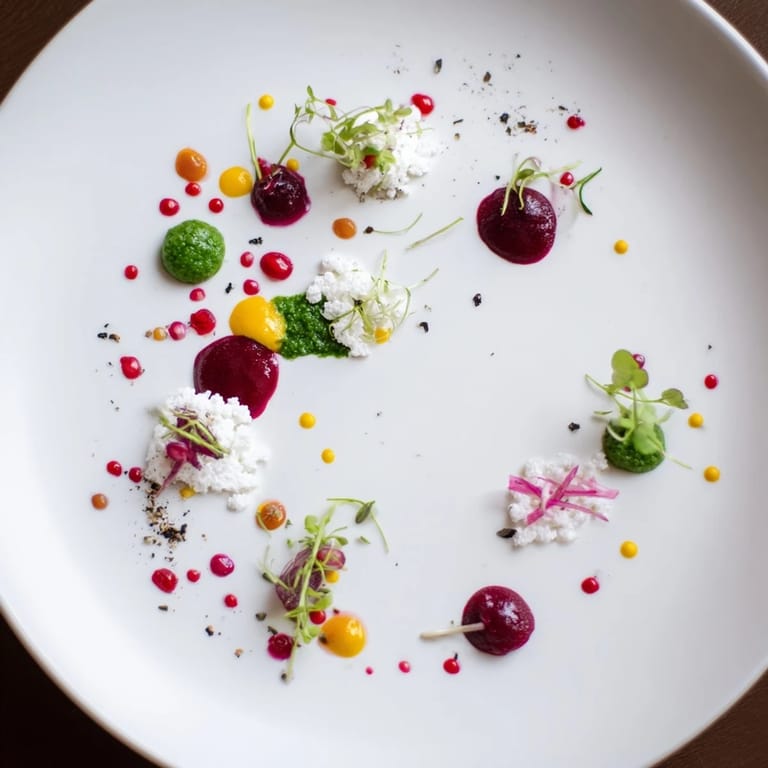
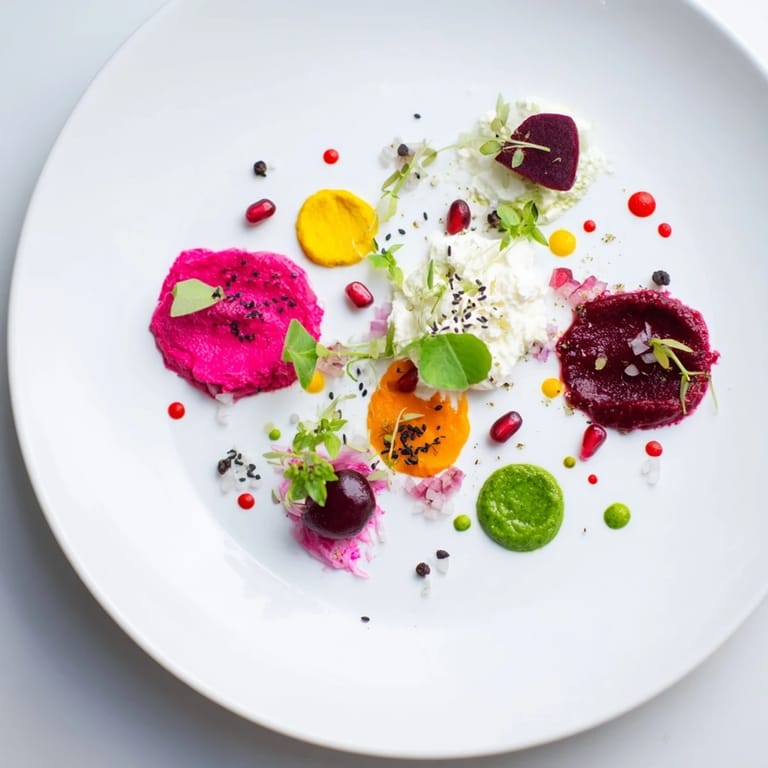
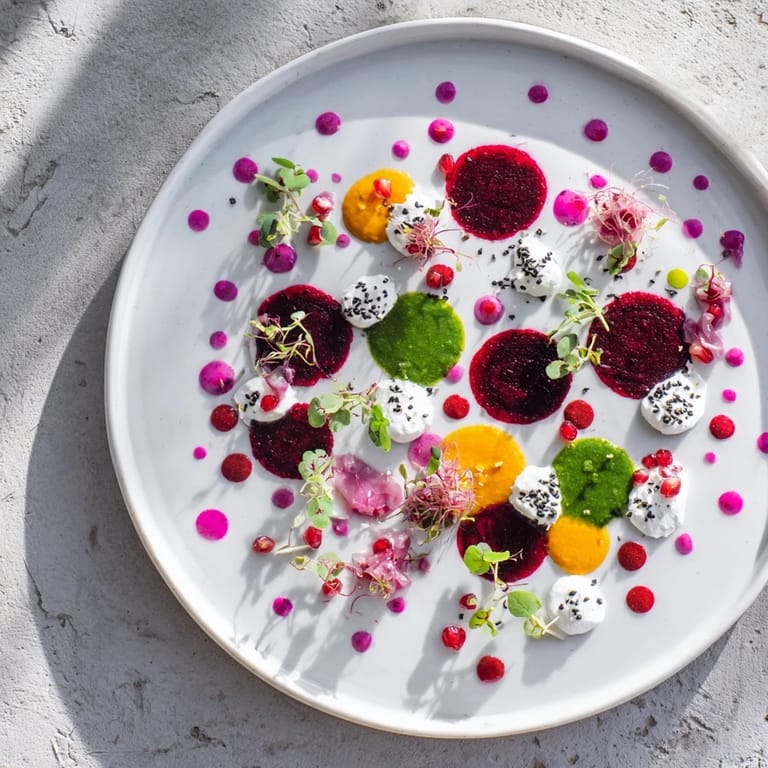
- Start with your purees, piping small dots and mounds across the plate in a loose, organic pattern. Think of Seurat's paintings—no rigid lines, no sections. Vary the size of each dot, some the size of a pea, others slightly larger. Leave space between them; touching dots lose their individual identity. Work around the plate so you're not leaning over wet elements.
- Layer in the sauces and creams:
- Now add your white dollops of yogurt and crème fraîche, distributing them to balance colors. Then use your squeeze bottles for the pesto, coulis, and balsamic, creating fine lines and dots that weave through the composition. Think of these as the final glaze in a painting.
- Finish with flourish:
- Sprinkle pickled onions, sesame seeds, and pomegranate seeds over the entire composition with restraint—each garnish should be visible as its own accent, not buried. A few microgreens tucked strategically, a whisper of edible flowers if using them, then a final grind of black pepper and pinch of fleur de sel. Step back, look at the plate from above, and adjust any gaps or imbalances.
- Serve with intention:
- Bring the plate directly to the table while everything is still perfectly positioned. Serve with crisp crackers or toasted bread on the side so guests can either eat the dots with their hands or use a fork and cracker to combine flavors as they wish.
 Pin it
 The first time I made this for guests, I was so focused on the visual that I forgot it also had to taste extraordinary. A dear friend's grandmother, visiting from Italy and skeptical of modern plating, took one bite that combined beet, basil, and pomegranate all at once, and her face shifted. She closed her eyes and said, 'This is art that feeds people.' That moment reminded me that beauty on a plate is only half the story—it's the unexpected burst of flavor, the interplay of textures, the way your palate gets surprised by what comes next that transforms dinner into memory.
The Art of Strategic Color
Color theory matters here in a very practical way. The jewel tones of beetroot, the warm golds of carrot and pepper, the bright spring of green peas—they create natural contrast without you having to think about it. But where you place them does matter. I've learned to balance warm tones with cool ones, never letting reds cluster in one corner while greens crowd another. Imagine the plate as a painting where your eye should travel around the perimeter and across the center, never getting stuck in one spot. The pomegranate seeds and microgreens act as visual resting points, breaking up the heavier purees with flecks of brightness.
Building Flavor Layers
What makes this dish sophisticated is that each dot delivers a different flavor story. The beet with balsamic tells a different tale than the carrot with basil or the pepper with crème fraîche. As you eat, you're not trying to find the 'right' combination of flavors on your plate—instead, every spoonful is its own complete thought. This is why the order of plating matters subtly; when a diner's fork naturally guides them through the composition, they experience the flavors in an intentional sequence that feels inevitable rather than random.
Mastering the Technique
The tools you use transform this dish from complicated to achievable. Piping bags are more forgiving than you'd expect, and even if your dots aren't perfectly round, the slight irregularity adds to the handmade, artistic feeling. If piping bags intimidate you, use the back of a small spoon or even squeeze bottles for everything—the look is different but equally charming. Practice on a plate with no audience first; you'll be amazed how quickly your hand steadies and your confidence builds. The tweezers mentioned in the ingredient list are optional but genuinely helpful for positioning microgreens and edible flowers with precision—they let you adjust placement without disturbing what you've already piped.
- Keep all your piping bags and tools at room temperature for smooth, easy piping that doesn't require squeezing with desperate force
- Have a damp cloth nearby to wipe the tip of each piping bag between colors so flavors and hues don't muddy each other
- If a dot lands where you don't want it, you can lift it away with the tip of a damp knife or tweezers before it sets
 Pin it
 This dish taught me that cooking and art aren't separate languages—they're the same conversation expressed through different mediums. Every time I make it, I remember why I fell in love with feeding people.
Recipe FAQ
- → What ingredients create the vibrant colors?
Beetroot, carrot, green pea, and yellow bell pepper purees provide bright natural colors that form the base of this dish.
- → How is the pointillism effect achieved on the plate?
Small dots and mounds of purees, sauces, and creams are carefully piped in scattered, non-touching patterns of varied sizes and colors.
- → Can this dish be adapted for different diets?
Yes, using plant-based yogurt and omitting crème fraîche creates a vegan version without sacrificing flavor or presentation.
- → What garnishes enhance flavor and texture?
Pickled red onions, microgreens, toasted black sesame seeds, pomegranate seeds, and edible flower petals add layers of taste and contrast.
- → What techniques are essential to plating this dish?
Using piping bags and squeeze bottles allows precise dot placement, while chefs tweezers help arrange delicate garnishes neatly.